

Lake Superior Endurance Swim
The opening chapter of The Great Lakes Mission.
Mission One is being developed as a staged, safety-led Lake Superior endurance swim — built around cold water, changing weather, navigation, crew, recovery and disciplined decision-making under real conditions.
Mission One is currently planned for 2027, but the exact timing remains open and will depend on operational readiness.
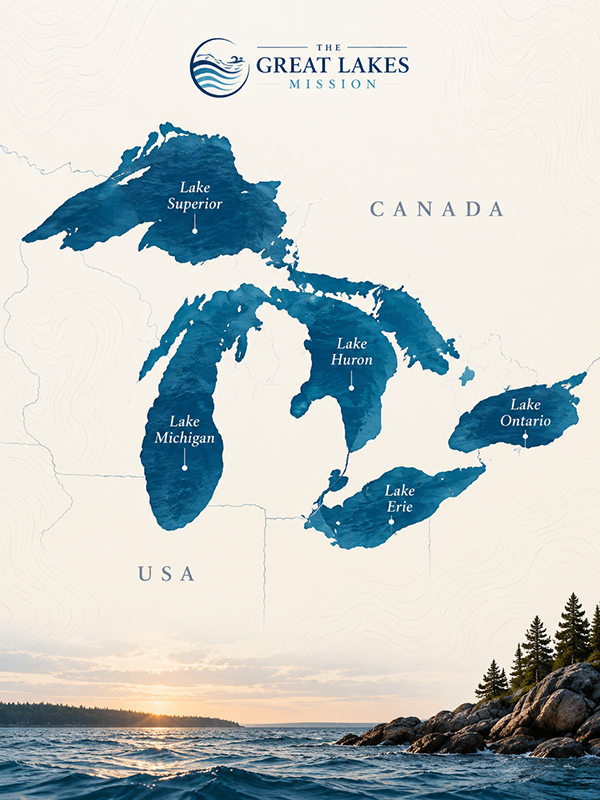
31,700 sq mi
82,100 km² of water surface
1,332 ft
406 m maximum depth
350 mi
About 560 km long
Cold. Deep. Vast.
Largest, deepest and coldest of the Great Lakes.
WHY LAKE SUPERIOR?
Lake Superior is not simply large. It behaves like an inland sea.
The U.S. National Park Service describes a lake that shapes its own weather and climate, with cold water, fog, sudden squalls, waves and rapidly changing conditions. The U.S. EPA lists a water surface of 31,700 square miles and a maximum depth of 1,332 feet.
That combination of scale, cold, exposure and change is exactly why Mission One must be built around preparation rather than bravado.
Cold-water reality
NPS guidance for Lake Superior safety cites an average surface water temperature of about 40°F (4°C) and warns that fog and sudden squalls can quickly change conditions.
A STAGED END-TO-END MISSION
Mission One is being developed as a staged end-to-end endurance swim, not a nonstop crossing.
Each swim stage will be shaped by route planning, weather, water conditions, crew capacity, recovery, medical oversight and the practical realities of moving safely along one of the world’s great freshwater systems.
The final route, stage lengths, start point, finish point and operational windows will only be confirmed when the expedition plan is ready.
STAGED
Progress is built one operational stage at a time, with recovery and reassessment between stages.
ADAPTIVE
Weather, wind, fog, waves and crew decisions can change the day. The plan must be able to change with them.
DOCUMENTED
Route decisions, conditions, progress, setbacks and lessons will form the record of Mission One.
WHAT THE LAKE DEMANDS
Cold water and exposure. Energy management, feeding, recovery and clear stop criteria must be planned before the first stage begins.
Weather and waves. Lake Superior can produce fog, strong wind, sudden squalls and sea-like wave conditions. Weather intelligence is part of the expedition itself.
Navigation and decisions. A staged mission depends on positioning, route continuity, marine forecasts, communications and the discipline to adapt or stop when conditions require it.
Crew, medical and recovery. The swim is only one part of the expedition. Crew readiness, medical oversight, nutrition, recovery and vessel operations must function as one system.
SAFETY FIRST. ALWAYS.
The current operational concept includes a main support vessel, a dedicated rescue boat, navigation and weather systems, marine communications and Satcom, medical oversight, hypothermia protocols, recovery and nutrition support, and Mission Control for tracking and updates.
No launch will be announced simply because a calendar says it is time. The mission moves when the systems, people, funding and conditions are ready.
CURRENTLY PLANNED FOR 2027
Mission One is currently expected to take place in 2027. The exact timing remains open and will only be confirmed once route, crew, vessels, permissions, safety systems, funding and weather windows align.
Mission One starts with preparation.
MORE THAN A SWIM
SWIM AGAINST CANCER is the purpose beyond the water. The mission is being developed to use visibility, storytelling and partnerships to support mental-strength coaching and meaningful experiences for children facing cancer — while remaining clear that this is not medical treatment and makes no promise of healing.
FOLLOW MISSION ONE FROM THE BEGINNING
Training, route development, crew building, safety planning, sponsorship, setbacks, decisions and film documentation all begin before the first stroke.
Lake facts and cold-water context are based on U.S. EPA and U.S. National Park Service information for Lake Superior.